Now that we’ve entered 2026, an important realization sets in:
We are closer to 2030 than we are to 2020.
For organizations with zero waste and emissions goals aligned to 2030, that matters a lot. The once-distant future is no longer theoretical. The clock is ticking, and the question is no longer what your goals are, but whether you are on a realistic path to achieve them.
Rethinking Time: Why 2030 Is Closer Than It Feels
Most people have a flawed understanding of time. We use clocks to measure it, and because clocks are circular, we tend to think time works the same way. It’s 4:14 today, it will be 4:14 tomorrow, and again the next day.
But that’s an illusion.
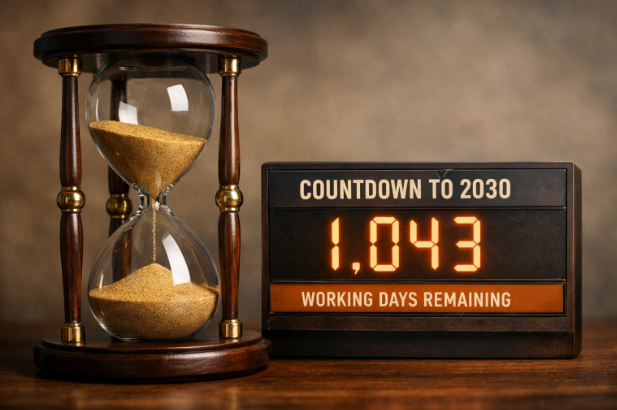
Time is not circular. It is linear and finite. A better representation of time is an hourglass. Each grain of sand falls only once, never to return. When it’s gone, it’s gone.
As of January 1, 2026, there are exactly 1,043 working days until January 1, 2030.
Many organizations set their sustainability commitments closer to 2015, when 2030 felt almost like science fiction. But Father Time is undeterred and now, momentum is accelerating. For many organizations, more than half of the allotted time to reach these ambitious goals has already passed.
The real question is this:
Is your organization on an achievable path toward its 2030 commitments?
The Steepest Part of the Climb Comes at the End
At Okapi Environmental Services, we’ve seen this pattern repeatedly:
Getting from 0% to 70% diversion or emissions reduction is often easier than going from 70% to 90%.
The final stretch is typically the steepest and the most complex. By the time organizations reach the 50–70% range, many have already exhausted their initial ideas, training programs, and strategies. At this stage, the effort often shifts from making progress to simply preventing backsliding, whether due to:
- Personnel changes
- Shifting priorities
- Data limitations
- Unsustainable implementation methods
In other words, progress is not linear.The first 25% of a goal rarely takes 25% of the allotted time. Conversely, the final 25% may take 50% or more of the total timeframe. This stage requires granular expertise, durable strategy design, team alignment, and creative, out-of-the-box thinking.
A Four-Pronged Approach for the Second Half of the Journey
Based on decades of experience, the Okapi Environmental Services team recommends a focused, four-pronged approach to reassessing and advancing sustainability goals:
- Reconstruct the Timeline
- Rebuild your roadmap using the remaining years and days to 2030. Develop a revised Gantt chart and distribute it to all stakeholders, including corporate leadership.
- Rebuild your roadmap using the remaining years and days to 2030. Develop a revised Gantt chart and distribute it to all stakeholders, including corporate leadership.
- Evaluate Your Data and Measurement Systems
- Are your data sources accurate and reliable? Do they automatically ingest data, or are they dependent on manual spreadsheets? Measurement gaps can quietly undermine progress.
- Are your data sources accurate and reliable? Do they automatically ingest data, or are they dependent on manual spreadsheets? Measurement gaps can quietly undermine progress.
- Assess Lessons Learned So Far
- What insights has the first half of the journey provided? Do you have sufficient financial and personnel resources? What has worked well and where are improvements needed?
- What insights has the first half of the journey provided? Do you have sufficient financial and personnel resources? What has worked well and where are improvements needed?
- Modify for the Final Climb
What adjustments are required to successfully complete the second half of the journey? This is where strategy must evolve to match reality.
The OPTIMUM Experience: Where Many Efforts Falter
Okapi Environmental Services applies the OPTIMUM Experience when evaluating these challenges. The final components of the framework focus on:
- Measurement
- Understanding
- Modification
This is the continuous improvement loop and it is often where sustainability efforts stall or fail. Measurement without understanding leads to confusion. Understanding without modification leads to stagnation.
For progress to continue, this loop must be anchored to a clear:
- Plan, and Timeline
Goals without timelines, actionable plans, and continuous improvement strategies tend to result in prolonged, difficult conversations with stakeholders, employees, and corporate offices, without meaningful progress.
Why Q1 of 2026 Matters More Than Ever
We believe the beginning of this new year is a critical moment to re-evaluate measurable progress and to be unapologetically realistic about what it will take to achieve your 2030 goals within the remaining time.
Integrating this work into first-quarter planning is one of the most valuable investments a sustainability professional can make.
If you find yourself stalled or simply unsure whether your organization is truly on track we’re here to help. You can schedule time with our team for an Executive Briefing to discuss your sustainability journey and next steps.
With 2030 quickly approaching, now is the time to reassess your sustainability strategy. Okapi Environmental Services partners with organizations to turn commitments into measurable outcomes, so schedule an executive briefing to evaluate your progress and define a realistic, achievable path forward.
Because time is moving quickly, and every day counts.
Schedule a call below.
) Back to the blogs page
Back to the blogs page by Fahrenheit Marketing